
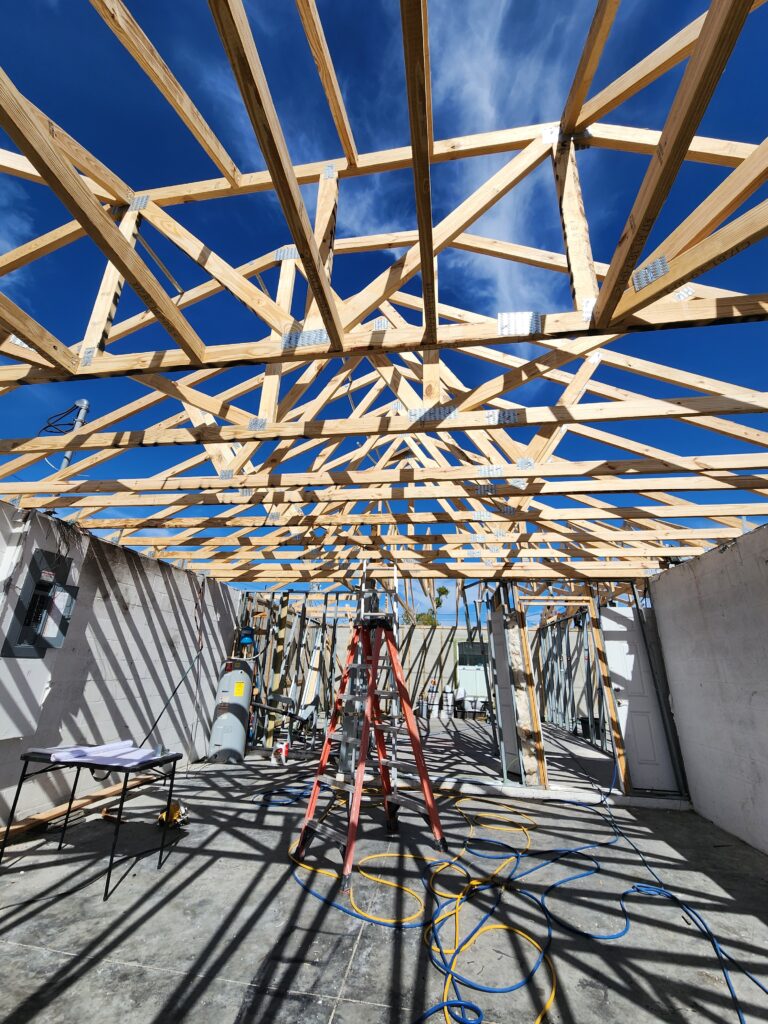
There comes a point when owning an older waterfront home in Cape Coral begins to feel less like enjoying a valuable piece of real estate and more like maintaining an increasingly expensive liability.
The roof is aging. The windows are outdated. The air conditioner works harder than it should. Insurance premiums continue consuming money that could otherwise be invested in the property itself.
And when the homeowner finally decides it’s time for a major renovation, another obstacle can appear.
FEMA’s 50% Rule.
For many older homes in Cape Coral’s regulated flood zones, this rule can significantly affect how much renovation or repair work can be performed without triggering requirements to bring the structure into compliance with current floodplain construction standards.
But what if the better financial decision isn’t renovating the old house at all?
What if demolishing the existing structure and building a modern custom home could reduce ongoing expenses, improve hurricane resilience, create a dramatically better living environment, and potentially increase the value of the property?
For some Cape Coral homeowners, that possibility deserves serious consideration.
Table of Contents
- What Is FEMA’s 50% Rule?
- How the 50% Rule Affects Renovations
- The Hidden Expense of Flood Insurance
- Could a New Home Eliminate the Flood Insurance Requirement?
- How Much Does It Cost to Demolish a House in Cape Coral?
- When Rebuilding Makes More Sense Than Renovating
- A New Generation of Hurricane-Resistant Construction
- Lower Energy Bills and Better Comfort
- The Luxury of a Quieter, More Comfortable Home
- Turning an Aging Property Into Equity
- The Financial Case for Rebuilding
- Frequently Asked Questions
- Building Something Better With Conquest Builders
What Is FEMA’s 50% Rule in Cape Coral?
FEMA’s 50% Rule is one of the most important regulations homeowners should understand before planning a major renovation or repairing significant damage to an older home in a regulated flood zone.
Under the National Flood Insurance Program, when the cost of improvements or repairs to a structure in a Special Flood Hazard Area equals or exceeds 50% of the structure’s applicable market value, the building may be classified as substantially improved or substantially damaged.
When that threshold is reached, the structure generally must be brought into compliance with current floodplain construction requirements.
Here is the detail many homeowners overlook.
The calculation is based on the value of the structure—not the combined value of the house and land.
Imagine owning a waterfront property worth $700,000. The land may account for $400,000 of that value, leaving the existing structure valued at approximately $300,000.
In that hypothetical example, a renovation or repair project reaching $150,000 could trigger the substantial improvement or substantial damage threshold.
That can create a serious problem for a homeowner who was planning a major renovation but never intended to reconstruct the home to current flood elevation standards.
Cape Coral administers these requirements through its floodplain management program. Homeowners should confirm their property’s flood zone, structure valuation, applicable calculation period, project scope, and compliance requirements with the City before beginning work.
For the City’s official explanation, visit Cape Coral’s Flood Protection and Substantial Improvement guidance.
How the 50% Rule Can Turn a Renovation Into a Much Larger Project
Renovating an older home can be a wonderful investment when the existing structure is in good condition and the improvements make financial sense.
But major renovations can become complicated when the house sits below current flood elevation requirements.
Consider a homeowner planning a new kitchen, bathrooms, flooring, electrical improvements, windows, and extensive interior remodeling.
What begins as an exciting renovation may approach the substantial improvement threshold before the homeowner has addressed the aging roof, older plumbing, inefficient insulation, or other expensive systems.
And when substantial damage is involved, the cost of restoring the structure to its pre-damage condition matters even if the owner intends to complete fewer repairs.
The rule is not simply a limit on how much money a homeowner is allowed to spend. It is a threshold that can trigger additional floodplain compliance obligations.
For a noncompliant older home, those obligations can change the feasibility and economics of the entire project.
At that point, we believe homeowners should seriously consider another question.
Instead of spending heavily to preserve an aging structure, would that money create more value in a completely new home?
The Hidden Expense of Flood Insurance on Older Cape Coral Homes
One of the most significant ongoing expenses facing certain older waterfront homeowners is flood insurance.
Premiums vary enormously based on the individual property, elevation, flood risk, construction characteristics, coverage, deductibles, and insurance provider.
Some older, higher-risk properties can face extremely expensive premiums. A homeowner paying $12,000 annually for flood insurance is spending $1,000 every month before paying for electricity, maintenance, property taxes, or ordinary homeowners insurance.
That $12,000 figure is an illustrative high-premium scenario, not the average Cape Coral flood insurance premium. Homeowners should use their actual renewal quotes when evaluating a property.
But consider the mathematics for someone who really is paying that amount.
Ten years of $12,000 annual premiums equals $120,000.
Twenty years equals $240,000.
And that assumes premiums never increase.
That is a substantial amount of money to spend protecting an older structure without necessarily improving the structure’s condition, comfort, or market appeal.
Insurance serves an important purpose, and premiums are not automatically recoverable through rebuilding. However, when evaluating the long-term economics of an older home, these ongoing expenses deserve just as much attention as the cost of a renovation.
Could Building a New Home Eliminate the Flood Insurance Requirement?
Possibly. But this is an area where understanding the distinction between flood risk, flood-zone classification, and building elevation is extremely important.
A new home constructed to modern floodplain requirements may be elevated significantly above the living-floor elevation of the older structure it replaces.
That can reduce flood exposure and may result in substantially different flood insurance pricing.
However, building a new home above the required flood elevation does not automatically eliminate the requirement to carry flood insurance.
If the property remains within a FEMA Special Flood Hazard Area and the homeowner has a federally regulated or federally backed mortgage subject to mandatory flood insurance requirements, coverage generally remains required.
A property outside the Special Flood Hazard Area, such as one classified in Zone X, may not be subject to that federal mandatory-purchase requirement. Some lenders may still require coverage, and flood insurance remains worth considering because lower risk does not mean zero risk.
In certain circumstances, property-specific elevation documentation and a FEMA map amendment process may establish that a qualifying structure or property should no longer be classified within the mapped Special Flood Hazard Area. Eligibility must be established through the appropriate process; simply constructing a higher home is not enough.
The financial opportunity is therefore twofold.
First, a new home designed with appropriate flood elevations and modern construction methods may qualify for meaningfully different insurance premiums.
Second, where a property genuinely qualifies to have the mandatory flood insurance requirement removed, the homeowner may no longer be obligated by federal lending rules to purchase coverage.
For someone currently spending $12,000 annually, eliminating that expense could free up $1,000 per month. Even reducing the premium substantially could create meaningful savings.
Neither outcome should be assumed before obtaining property-specific flood-zone information, elevation documentation, lender confirmation, and insurance quotes.
Homeowners can learn more from the National Flood Insurance Program’s flood-zone guidance.
How Much Does It Cost to Demolish a House in Cape Coral?
One of the first concerns homeowners have about starting over is the cost of removing the existing house.
Fortunately, demolition is often a relatively small portion of the overall investment in a new custom home, although the actual cost varies significantly by property.
Published Cape Coral demolition pricing guides commonly describe approximately $10,000 to $30,000 for a full residential demolition, with larger or more complicated projects potentially costing $40,000, $50,000, or more.
Those figures are preliminary market estimates rather than a guaranteed local contractor quote.
A smaller, accessible single-story house may be relatively straightforward to remove. A larger concrete masonry home with extensive foundations, difficult access, hazardous materials, or complicated utility disconnections can require considerably more work.
In Cape Coral, demolition planning may also involve protecting an existing seawall, preserving selected site improvements, managing neighboring properties, and determining whether an existing pool or other structures should remain.
Permitting, disposal, environmental testing, utility coordination, and site preparation should all be considered when developing the budget.
But here is the more interesting comparison.
For a homeowner spending $12,000 annually on flood insurance, a hypothetical $24,000 demolition cost is equivalent to just two years of those premiums.
That does not make demolition free, and rebuilding introduces a much larger construction investment. It simply demonstrates why demolition cost should be evaluated within the entire financial picture rather than considered in isolation.
When Rebuilding Makes More Sense Than Renovating
There is nothing inherently wrong with renovating an older home.
In fact, when the structure is well built, properly elevated, and suited to the owner’s needs, renovation can be an excellent financial decision.
But some properties present a different equation.
Imagine a home with an aging roof, outdated windows, older electrical systems, inefficient insulation, limited ceiling heights, and a floor plan that no longer suits the family.
Now add expensive flood insurance and substantial renovation restrictions.
Suddenly, the homeowner may be preparing to spend hundreds of thousands of dollars improving a structure that still carries many of the limitations it had before the renovation.
They may end up with beautiful countertops, new flooring, and attractive cabinetry—but still have an older structural system, limited elevation, and a home that cannot be redesigned as freely as new construction.
At some point, it becomes reasonable to ask whether the better investment is preserving the old house or replacing it with one designed around current standards and modern expectations.
Sometimes the most valuable part of an older waterfront property is the land beneath it.
A New Generation of Hurricane-Resistant Construction
One of the greatest advantages of rebuilding is the opportunity to design the entire home around modern Florida building requirements.
Older homes were constructed under the codes and engineering standards applicable when they were built.
Some have been upgraded extensively. Others still contain original construction details that may not provide the same performance as a newly engineered structure.
Modern custom construction allows the foundation, structural connections, wall systems, roof assembly, impact protection, and building envelope to be designed together.
For example, properly engineered reinforced masonry, concrete, roof-to-wall connections, impact-rated windows and doors, and modern roof assemblies can create a strong and resilient home when designed and installed correctly.
The advantage is not simply using stronger materials.