
When most people think about upgrading a custom home in Cape Coral, they think about what they can see.
Better countertops. Larger-format tile. Custom cabinetry. Higher-end appliances. More elaborate lighting.
Those things matter. They help create a beautiful home.
But some of the upgrades that have the greatest impact on your everyday life are hidden behind the drywall.
At Conquest Builders, we believe the exterior walls of a home are one of them.
In Southwest Florida, our homes spend nearly every day fighting heat, humidity, intense sunshine and exterior noise. Building code establishes a minimum standard for how those homes need to perform.
But there is a significant difference between building a home that meets the minimum requirement and building one around the comfort of the people who will actually live there.
And when you look at the cost on a monthly basis in Cape Coral, building the better home may be far more affordable than most people realize.
Table of Contents
- Let the Concrete Take the Florida Sun
- Creating a Second Line of Defense
- Comfort You Can Actually Feel
- A Luxury Home Should Be Quiet
- What a $10,000 Upgrade Really Costs Each Month
- Because the Better Wall Can Reduce Another Monthly Bill
- And Electricity Probably Won’t Cost the Same Forever
- And Eventually, the Mortgage Ends
- Where Would You Rather Spend the Money?
- The Things You Can’t See May Matter the Most
- Building for Quality of Life
- Frequently Asked Questions
Let the Concrete Take the Florida Sun
Concrete masonry construction is extremely common in Southwest Florida; and for good reason.
CMU provides a strong, durable exterior structure that is well suited to our environment.
But concrete block is not, by itself, a particularly effective insulation system.
When intense Florida sunshine strikes an exterior wall for hours, the exterior surface can become considerably hotter than the surrounding outdoor air. The masonry absorbs that energy and stores it.
Eventually, some of that heat works its way toward the conditioned interior.
Many Florida homeowners have experienced the result without necessarily knowing the cause.
The air conditioner is running. Most of the house feels comfortable. But one bedroom facing the afternoon sun consistently feels warmer than the rest of the home.
We believe there is a better way to approach that wall.
Creating a Second Line of Defense
Instead of treating the inside of the concrete block as essentially the beginning of the living space, a higher-performance wall can create greater separation between the masonry shell and the conditioned home.
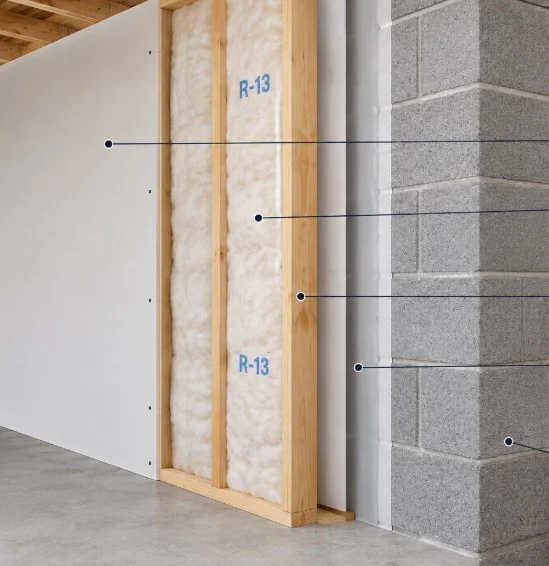
One approach we’re exploring uses the structural CMU exterior wall followed by a designed separation and a dedicated insulated framed wall on the interior.
Conceptually, the assembly becomes:
Exterior Finish → Structural CMU → Separation → Insulated Framed Wall → Drywall → Conditioned Home
The exact assembly—including insulation, air sealing and moisture management—must be properly designed for Southwest Florida’s hot-humid climate.
But the basic idea is simple.
Let the concrete deal with the Florida sun. Then create a much stronger thermal barrier between that hot masonry and the family living inside.
The result isn’t simply a better R-value on a construction specification.
It’s a different living environment.
Comfort You Can Actually Feel
Energy efficiency is often discussed in terms of percentages, R-values and equipment ratings.
Homeowners don’t experience any of those things.
They experience the bedroom that’s several degrees warmer every afternoon.
They experience an air conditioner that seems to run constantly.
They experience sitting next to an exterior wall that feels noticeably warmer than the rest of the room.
A better-insulated building envelope can help reduce those differences.
Rooms can maintain more consistent temperatures. Interior wall surfaces can remain more comfortable. The HVAC system has less heat to remove from the house.
Instead of continually using mechanical equipment to correct for heat that has already entered the living environment, we’re trying to prevent more of that heat from getting there in the first place.
But temperature may not even be our favorite benefit.
A Luxury Home Should Be Quiet
Luxury is usually presented visually.
We think that’s incomplete.
Close your eyes inside a truly great home and you should still be able to experience the difference.
Traffic should seem farther away.
The neighbor’s lawn equipment should be less intrusive.
A vehicle leaving early in the morning shouldn’t necessarily wake someone sleeping in the bedroom beside the driveway.
Rain, pool equipment, construction and the countless noises surrounding our homes should have less influence on the environment inside.
This is particularly important for light sleepers.
The World Health Organization recognizes environmental noise as an important cause of sleep disturbance and recommends nighttime bedroom noise levels below approximately 30 dBA for continuous noise to support good-quality sleep. Research reviewed by WHO has also found that nighttime noise can produce physiological responses, brief arousals and changes in sleep structure even when someone doesn’t consciously remember waking up.
That’s important because sleep isn’t simply about whether you remember waking during the night.
It’s also about the quality and continuity of the sleep you get while you’re there.
A concrete masonry exterior already provides substantial mass for reducing sound transmission. Creating additional separation, insulation and another wall assembly provides an opportunity to further isolate the living environment from exterior noise when the complete assembly is properly designed.
For someone who sleeps lightly, that could affect their quality of life virtually every night they live in the home.
That’s difficult to put a price on.
But we can certainly compare it to the price of building the better wall.
What a $10,000 Upgrade Really Costs Each Month in Cape Coral
This is where the economics become interesting.
Imagine that an enhanced exterior wall system adds approximately $10,000 to the price of a new home.
It sounds significant when presented as a lump sum.
But most homeowners purchasing a new custom home aren’t paying the entire purchase price in cash.
At a hypothetical 4.875% fixed interest rate over 30 years, financing an additional $10,000 adds approximately $53 per month in principal and interest.
Now the question changes.
Instead of asking:
“Would I spend another $10,000 for better walls?”
We can ask:
“Would I spend another $53 per month for a quieter and more comfortable home?”
And even that doesn’t tell the entire story.
Because the Better Wall Can Reduce Another Monthly Bill
The homeowner isn’t paying $53 per month and receiving only additional comfort.
A better-insulated building envelope can also reduce the amount of energy required to cool the home.
Suppose, purely for illustration, that the improved construction reduces electricity costs by $35 per month.
Actual savings will vary significantly depending on the home, orientation, amount and type of glass, HVAC equipment, thermostat settings, utility rates and final wall design. We would never promise that every home will achieve a specific savings without modeling it.
But the example demonstrates the concept.
Additional mortgage payment: approximately $53/month
Illustrative energy savings: approximately $35/month
That leaves an effective difference of only:
Approximately $18 per month.
Now consider what that $18 is potentially buying.
A quieter bedroom. More consistent temperatures. Less afternoon heat gain. Reduced cooling demand. A more comfortable home. And a better-performing exterior envelope that becomes a permanent part of the structure.
Suddenly, this doesn’t look like a $10,000 insulation upgrade.
It looks like a potentially enormous improvement in quality of life for the effective cost of a few cups of coffee each month.
And Electricity Probably Won’t Cost the Same Forever
There’s another part of this equation that’s easy to overlook.
A fixed-rate mortgage payment is fixed. The price of electricity isn’t.
In our example, the additional principal-and-interest payment associated with the upgrade remains approximately $53 per month for the life of the fixed-rate loan.
But the insulation isn’t saving dollars.
It’s saving energy.
If the home requires fewer kilowatt-hours to remain comfortable, every one of those avoided kilowatt-hours becomes more valuable if electricity prices increase.
Consider our hypothetical $35 monthly energy savings.
If electricity becomes 20% more expensive, the same amount of avoided energy consumption would be worth approximately $42 per month.
At 40% higher electricity prices, it would be worth approximately $49 per month.
At roughly 50% higher electricity prices, those same energy savings would be worth approximately $52.50 per month—almost the entire additional mortgage payment in our example.
We don’t need to predict what electricity will cost 10, 20 or 30 years from now to understand the principle.
The financing cost can be fixed. The value of the energy you don’t need to purchase can increase.
And Eventually, the Mortgage Ends
There’s one more difference between these two expenses.
Eventually, you make your last mortgage payment.
The wall doesn’t disappear when you do.
The insulation remains. The thermal separation remains. The acoustic benefits remain. And the reduced energy consumption remains.
If that home is standing 50 years from now, the decisions made while constructing its walls can still be affecting the comfort and energy consumption of the people living there.
That’s one of the reasons we believe it makes sense to invest in the components of a home that are extremely difficult to change later.
Countertops can be replaced.
Appliances can be upgraded.
Light fixtures can be changed.
Opening every exterior wall of a completed home because you wish it had been built differently is another matter entirely.
Where Would You Rather Spend the Money?
Ultimately, this creates a very different way of looking at the cost of better construction.
Imagine two homeowners.
One spends less building the house but pays more every month to remove heat that enters through the building envelope.
The other invests more into the house itself, finances that investment over a long period and potentially recovers a portion of the additional monthly payment through lower energy consumption.
Both homeowners are spending money.
They’re simply spending it in different places.
One sends more of it to the utility company.
The other puts more of it into the house.
And the homeowner who invested in the house gets something else in return every single day:
A quieter, more comfortable living environment.
The Things You Can’t See May Matter the Most
There will always be ways to make a home less expensive to build.
The question is whether those savings actually create value for the homeowner.
Insulation disappears behind drywall.
Waterproofing gets covered.
Air-sealing details are almost impossible to show someone after the home is completed.
Structural improvements aren’t as exciting to photograph as a beautiful kitchen.
But these hidden components determine an enormous amount about what it’s actually like to live in the home.
We don’t believe a luxury home should simply look luxurious.
It should feel different when the afternoon sun is beating against the exterior walls.
It should sound different when someone drives past the house at night.
The bedrooms should feel like retreats.
Temperatures should remain consistent.
The mechanical systems should have less work to do.
And when your head hits the pillow at night, the quality of the construction surrounding you should still be providing value—even though you can’t see any of it.
Building for Quality of Life
There’s an understandable tendency in construction to ask:
“What’s the payback period?”
That’s an important question.
But we think there’s another one that’s equally important:
“How much better will my life be during the payback period?”
If better construction can lower energy consumption enough to offset a meaningful portion of its additional monthly financing cost, then the homeowner isn’t simply waiting years for an investment to finally become worthwhile.
They’re receiving the return immediately.
They receive it in comfort.
They receive it in quiet.
They receive it in more consistent temperatures.
They may receive it in lower energy bills.
And for light sleepers, they may experience it every single night.
If the effective difference in monthly cost is relatively small, the decision becomes much easier.
Which home would you rather live in for the next 30 years?
At Conquest Builders, we’d choose the quieter one.
The more comfortable one.
The more efficient one.
The one designed around the people living inside it rather than simply the minimum requirements needed to build it.
Because a better building experience shouldn’t end when we hand you the keys.
It should improve the experience of living in your home for decades to come.
Frequently Asked Questions
Is upgrading exterior wall insulation worth it in Southwest Florida?
It can be, particularly when the wall system is properly designed for Southwest Florida’s hot-humid climate. A higher-performing exterior envelope may improve interior comfort, reduce heat transfer, lower cooling demand and provide additional opportunities for exterior noise reduction. The value should be evaluated as part of the complete wall and HVAC design rather than by insulation R-value alone.
Does concrete block insulate a Florida home in Cape Coral?
Concrete masonry provides strength, durability and substantial mass, but CMU alone should not be confused with a complete high-performance insulation system. The overall thermal performance of the exterior wall depends on the complete assembly, including insulation, air sealing, finishes, moisture management and other components.
Can better exterior walls make a home quieter?
Potentially, yes. Sound performance depends on the complete wall assembly, but additional mass, separation, insulation, air sealing and properly designed windows and doors can all influence how much exterior noise reaches the conditioned living space.
Can better insulation lower air-conditioning costs in Florida?
A better-performing building envelope can reduce the amount of heat the HVAC system needs to remove from the home. Actual energy savings depend on factors including orientation, windows, air leakage, HVAC efficiency, thermostat settings, utility rates and the final building-envelope design, so savings should be modeled rather than assumed.
Should I spend more on insulation or luxury finishes?
That depends on your priorities, but components hidden inside the structure deserve special consideration because they can be extremely difficult and expensive to improve after construction. Countertops, appliances and decorative fixtures can usually be replaced later. Rebuilding an exterior wall assembly is considerably more involved.
What should I prioritize when building a luxury home in Southwest Florida?
We believe the best approach balances what you can see with what you cannot. Architecture and finishes matter, but so do the building envelope, windows, insulation, waterproofing, structural systems, HVAC design and other components that influence comfort and performance every day.
Build a Home That Performs as Beautifully as It Looks
A luxury custom home in Cape Coral should be more than an impressive collection of finishes.
It should be comfortable when the Southwest Florida sun is at its strongest. Quiet when the world outside isn’t. Efficient when the air conditioner is working through another Florida summer. And thoughtfully constructed in the places you’ll never see again after the drywall goes up.
If you’re considering building a custom home in Cape Coral, Naples, Fort Myers, Bonita Springs or elsewhere in Southwest Florida, Conquest Builders can help you evaluate where better construction can create meaningful long-term value—not simply a higher construction price.
A Better Building Experience, Guaranteed.
Conquest Builders Corp.
Custom Homes | Southwest Florida